
When to Prune Hydrangeas and Other Shrubs in Massachusetts
· By Vantuir F. Procopio
If your hydrangeas leafed out beautifully but never flowered, the most likely cause is pruning at the wrong time. Knowing when to prune hydrangeas, and every other flowering shrub in your yard, comes down to one question: does this plant bloom on last year's wood or on this year's new growth?
This guide gives you a Massachusetts pruning calendar built around that question. It covers the shrubs we see most often in MetroWest yards, from the bigleaf hydrangeas lining older Framingham capes to the lilacs and rhododendrons on larger lots in Sherborn and Hopkinton. The timing follows the general guidance you will find from UMass Extension and other New England horticulture programs, adjusted for our short season and early frosts.
The one rule that decides when to prune any shrub
Flowering shrubs fall into two groups. Old wood bloomers form next year's flower buds during the summer and fall before they bloom. If you cut them in fall, winter or early spring, you remove those buds and lose the flowers. The safe window is right after they finish blooming.
New wood bloomers form flower buds on stems that grow in the current season. You can prune them in late winter or very early spring, before growth starts, and they will still flower that summer. In Massachusetts that window usually runs from late February through early April, depending on the year.
A quick way to remember it: if a shrub blooms before about mid June, prune it right after the flowers fade. If it blooms in mid to late summer, prune it in late winter or early spring.
When to prune hydrangeas (it depends on the type)
Bigleaf hydrangeas (Hydrangea macrophylla), the classic blue or pink mopheads and lacecaps, bloom mainly on old wood. Prune them lightly right after flowering, and finish by early August so the plant has time to set buds before frost. In spring, only remove stems that are clearly dead (no green under the bark) and cut old flower heads back to the first pair of fat, healthy buds. Reblooming varieties such as the Endless Summer series flower on both old and new wood, so they are more forgiving, but the same light touch still gives you the most flowers.
Oakleaf hydrangeas (Hydrangea quercifolia) also bloom on old wood. They need very little pruning. Shape them, if needed, right after bloom in summer.
Panicle hydrangeas (Hydrangea paniculata, such as Limelight and Quick Fire) and smooth hydrangeas (Hydrangea arborescens, such as Annabelle) bloom on new wood. Cut them back in late winter or early spring. Panicles can be shortened by about a third and thinned; smooth hydrangeas can be cut back harder, to roughly 12 to 24 inches, though leaving more stem helps keep the big flower heads from flopping.
Not sure which you have? Look at the leaves and flowers. Big, glossy leaves with round or flat blue or pink flowers usually mean bigleaf. Cone shaped white flowers that age to pink mean panicle. Large white snowball flowers on thin stems usually mean smooth hydrangea.
Lilacs, azaleas, rhododendrons and forsythia: prune right after bloom
These spring bloomers all set next year's buds in summer, so the window is short and comes right after flowering.
Forsythia blooms in April. Prune it in late April or May once the yellow flowers drop. Rather than shearing it into a ball, remove a few of the oldest, thickest canes at the ground each year to keep it full and arching.
Lilacs bloom in May in most MetroWest yards. Prune within a few weeks after the flowers fade, usually late May into June. Remove spent flower clusters and take out one or two of the oldest stems at the base. An overgrown lilac can be renewed over three years by removing about a third of the old stems each year.
Azaleas and rhododendrons bloom from May into June. Snap off spent flower trusses on rhododendrons carefully and do any shaping right after bloom. Avoid heavy pruning later in summer, or you will cut off next spring's buds, which are already forming by July.
Butterfly bush, roses and other summer bloomers
Butterfly bush (Buddleja) blooms on new wood. In Massachusetts it often dies back partway in winter. Wait until you see new growth in spring, usually April, then cut stems back to about 12 to 24 inches, or to wherever healthy buds appear.
Spirea that flowers in summer, rose of Sharon, and most shrub roses also bloom on new growth. Prune them in late winter or early spring before the buds break. Spring blooming spireas, like the white bridal wreath types, are the exception: prune them after they flower.
Hedges and evergreens: yews, boxwood, arborvitae
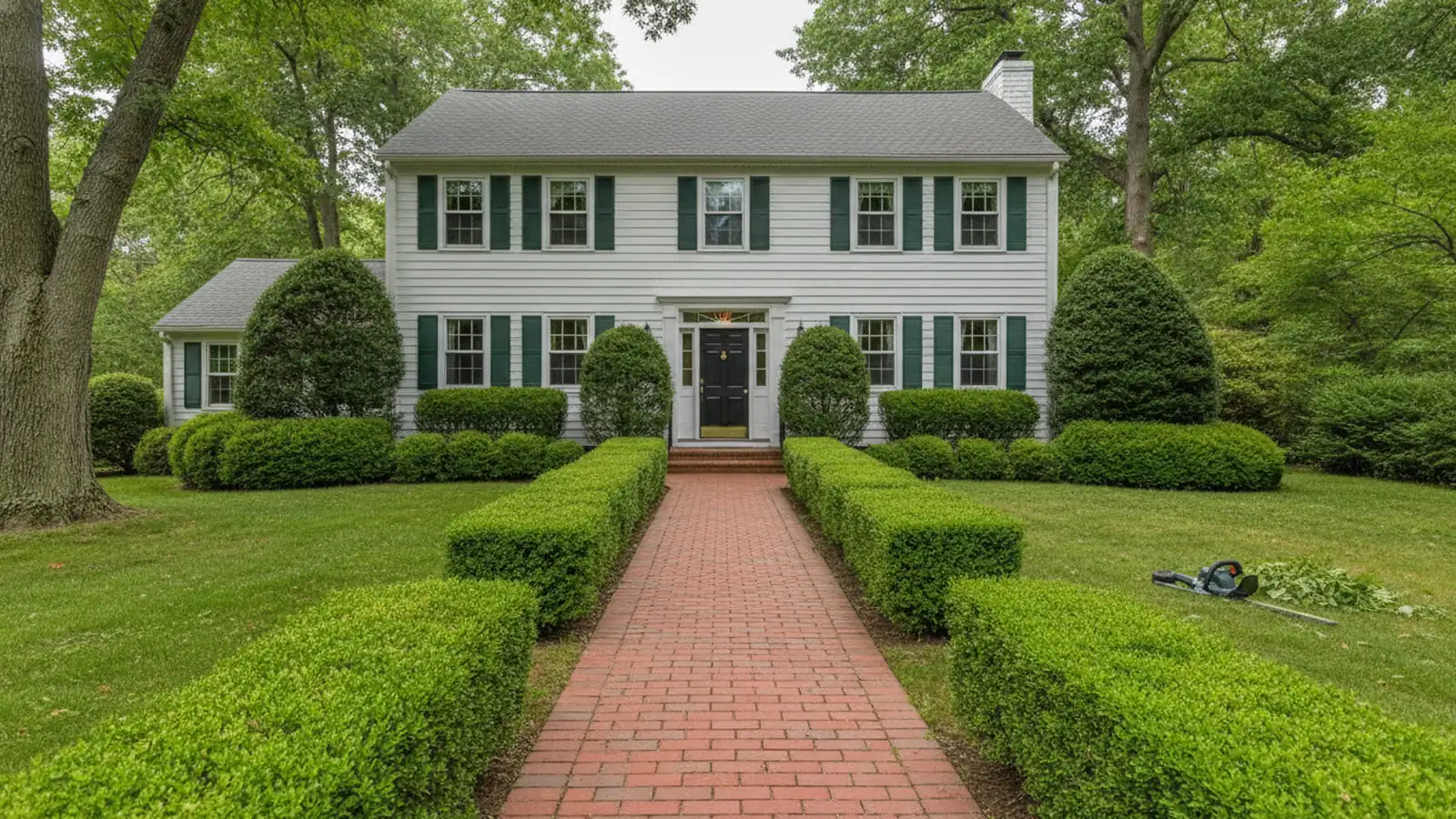
Formal hedges and foundation evergreens are pruned for shape, not flowers. Most homeowners get the best result with a first trim in late May or June, after the spring flush of growth hardens off, and an optional second, lighter trim in mid summer.
Stop shearing evergreens by around mid August. Late cuts push tender new growth that will not harden before our first frost, which usually arrives in October across MetroWest. That soft growth is easily damaged in winter.
Shape hedges so the bottom is slightly wider than the top. This lets sunlight reach the lower branches and keeps the base from going bare. It also helps the hedge shed snow instead of splaying open under heavy, wet storms.
Boxwood is best trimmed in late spring or early summer. Avoid shearing it in fall. Yews tolerate harder pruning than most evergreens and can be cut back in early spring if they have outgrown a window or walkway.
A month-by-month Massachusetts pruning calendar
Late February to early April: panicle and smooth hydrangeas, butterfly bush (once growth starts), summer spirea, rose of Sharon, shrub roses. Also remove dead, damaged or crossing branches on most shrubs, and repair winter and snow damage.
April to May: forsythia right after bloom. Light cleanup of bigleaf hydrangeas, removing only dead stems and spent heads.
Late May to June: lilacs, azaleas, rhododendrons and spring spirea right after bloom. First trim on hedges and evergreens.
July to early August: bigleaf and oakleaf hydrangeas right after flowering, if they need shaping. Second, lighter trim on hedges.
Mid August through fall: put the pruners away for most shrubs. Removing dead or broken wood is fine any time of year, but avoid shaping cuts until late winter.
Pruning mistakes that cost you flowers
The most common mistake is a fall cleanup that cuts every shrub back to the same height. That single pass can remove a full season of hydrangea, lilac and azalea blooms. A good fall cleanup leaves old wood bloomers alone.
The second is removing too much at once. As a general rule, take no more than about a third of a shrub in one season. Heavier cuts stress the plant and often trigger a mass of weak, leafy shoots.
Third, use clean, sharp tools and cut just above an outward facing bud or back to a main branch. Ragged cuts and stubs invite disease. If you would rather hand it off, the crew at Procopio Landscaping & Design handles hedge trimming and shrub pruning on this same calendar for homes across Framingham, Natick and nearby towns, with a free estimate and no visit fee.
Frequently asked questions
- When should I prune hydrangeas in Massachusetts?
- It depends on the type. Bigleaf and oakleaf hydrangeas bloom on old wood, so prune them lightly right after flowering and finish by early August. Panicle (Limelight) and smooth (Annabelle) hydrangeas bloom on new wood, so prune them in late winter or early spring, usually March to early April.
- Why did my hydrangea not bloom this year?
- For bigleaf hydrangeas, the usual causes are pruning in fall or spring, which removes the flower buds, or a cold winter or late spring frost that kills buds at the tips of the stems. Too much shade and heavy nitrogen fertilizer can also reduce flowering.
- Can I prune shrubs in the fall in Massachusetts?
- You can remove dead, broken or diseased branches any time. Avoid shaping cuts in fall. Spring bloomers have already set next year's buds, and late cuts on evergreens push tender growth that winter can damage. Late winter or right after bloom is a better window for most shrubs.
- When is the best time to trim hedges in MetroWest?
- Most hedges get their first trim in late May or June and an optional lighter trim in mid summer. Finish shearing by around mid August so new growth can harden before the first frost.
- How much of a shrub can I cut back at once?
- A safe guideline is no more than about one third of the plant in a single season. Overgrown shrubs like lilac, forsythia and yew are best renewed over two or three years by removing the oldest stems in stages.
Found this helpful? Make us a preferred source on Google.
Ready for an exact price?
Get a free, no-pressure in-home estimate. Real numbers for your home, not a phone guess.