
Lawn Mowing in Milford, MA: A Season-Long Guide to Height, Timing and Clippings
· By Vantuir F. Procopio
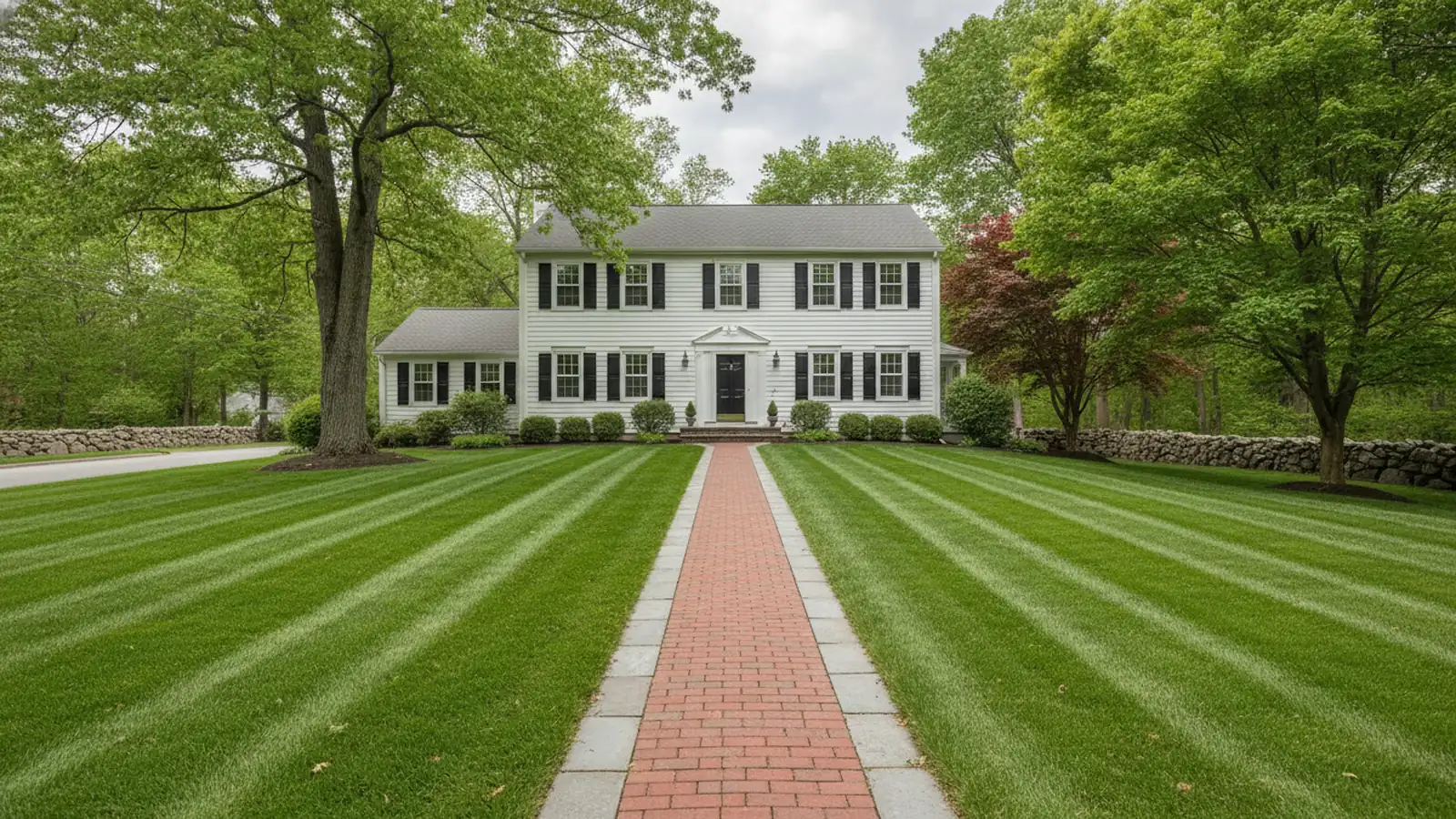
Lawn mowing in Milford, MA looks simple from the street, but the lawns that stay thick and green through August are the ones mowed on a steady schedule, at the right height, with sharp blades. Most of the damage we see in town is not from pests or disease. It is from cutting too short, mowing too late in the week, or letting the grass get away in May and then scalping it to catch up.
This guide walks through a full Milford mowing season: when to start, how high to cut, how often to mow in each month, what to do with clippings, and how the town handles leaves and yard waste in the fall. It is written for homeowners who mow themselves and for anyone deciding whether weekly service is worth it.
When the mowing season starts and ends in Milford
Milford lawns are almost all cool-season grasses: Kentucky bluegrass, fine fescues, tall fescue and perennial ryegrass, usually blended. These grasses wake up when soil warms in spring and slow down in the heat of midsummer, then grow hard again in September.
In a typical year the first real cut lands somewhere in April, once the lawn has greened up and the ground is firm enough that a mower will not leave ruts. Low spots near brooks and along the Charles River side of town often stay soft longer than lawns on higher, rockier ground, so it is worth walking the yard before the first cut. If your shoes sink in, wait a few more days.
The season usually ends in late October or into November, when growth stalls after a few hard frosts. The last mow of the year matters more than most people think, and we cover it below.
How high to cut: the single biggest decision
For the grass types common in Milford, a cutting height of roughly 3 to 3.5 inches through most of the season is a safe target. Taller grass shades the soil, keeps roots cooler, holds moisture longer and crowds out crabgrass seedlings that need sunlight to sprout.
The rule that keeps lawns healthy is the one-third rule: never remove more than one third of the blade in a single mow. If you want the lawn at 3 inches, cut it when it reaches about 4 to 4.5 inches. Cutting off half the blade at once stresses the plant, turns tips brown and invites weeds into the thin spots.
Many Milford yards sit on stony glacial soil, and some have exposed ledge or old granite close to the surface. On those areas, raise the deck a notch. A low blade over a bump or a buried rock scalps the turf down to bare dirt, and those scalped patches are where summer weeds show up first.
How often to mow, month by month
May and June are the busy months. With spring rain and mild temperatures, grass can grow fast enough that a weekly mow is the minimum to stay inside the one-third rule. In a wet stretch some lawns would honestly benefit from a cut every five or six days.
July and August are different. When heat and dry weather set in, cool-season grass slows down and may go partly dormant. Mowing a stressed lawn every week at a low height is how lawns burn out. Raise the deck to the top of the range, skip a week if the grass is not growing, and avoid mowing in the heat of the afternoon.
September and October bring a second growth spurt. Cooler nights and fall rain push the lawn hard again, and a weekly schedule usually returns. This is also the season when leaves start landing on the lawn, so mowing doubles as leaf management.
A weekly service is popular in Milford because it keeps the lawn on the right side of the one-third rule automatically, especially in May and June when a busy week can turn into an overgrown yard.
Clippings, blades and the small habits that add up
Leaving clippings on the lawn, often called grasscycling, returns nutrients and moisture to the soil. Short clippings from a regular mow break down quickly and do not cause thatch. The exception is when grass got too long: long, wet clippings clump and smother the turf underneath, and those should be raked or bagged.
Sharp blades matter. A dull blade tears the grass instead of slicing it, leaving ragged tips that turn brown and lose water. If your lawn looks grayish a day after mowing, the blade is likely dull.
Mow when the grass is dry, change the mowing pattern every few weeks so wheels do not rut the same lines, and keep the mower off soggy areas after heavy rain. Along beds and walkways, string trimming and a clean edge make the whole property look finished even when the lawn itself is average.
Watering rules and dry summers
Most of Milford is served by the Milford Water Company, a private water supplier, with Echo Lake as a key part of the supply. Outdoor watering restrictions in town have changed from year to year depending on drought conditions, ranging from limited schedules to near bans on lawn watering during dry summers. Check the Milford Water Company's current notices before setting up a sprinkler or irrigation timer each season.
When watering is limited, mowing higher is your best tool. Tall grass with deep roots survives a dry spell far better than short grass, and a dormant tan lawn in August usually greens back up once September rain returns. Avoid fertilizing a lawn that is dormant from drought, and keep foot traffic and heavy equipment off it until it recovers.
The last mow, fall leaves and Milford disposal options
For the final one or two mows of the season, lower the deck slightly, to around 2.5 to 3 inches. Shorter grass going into winter is less likely to mat down under snow, which helps prevent snow mold in spring.
Leaves should not sit on the lawn into winter. A thin layer can be mulched into the turf with the mower, but a thick mat of oak and maple leaves blocks light and smothers grass. In recent years the Town of Milford has run a residential leaf removal service in late fall. The rules in past years were clear: rake leaves to the edge of the sidewalk, or to the front property line if there is no sidewalk, do not rake them onto the sidewalk or into the street, do not bag them, and put out only leaves, with no grass, sticks, rocks or trash. Leaves had to be out by the Monday of your scheduled week. Dates change each year, so check the town's DPW page for the current schedule.
Milford also has a compost facility on Fiske Mill Road, off Route 140, that accepts leaves, grass and brush. It requires a Milford Transfer Recycling Station sticker, and its hours are limited to certain days, so confirm them with the Highway Department before you load the truck.
If you would rather hand off the mowing, Procopio Landscaping & Design is a family-owned crew based in neighboring Framingham that handles weekly lawn mowing and seasonal cleanups in Milford. Estimates are free, there is no visit fee, and the team speaks English, Portuguese and Spanish.
Frequently asked questions
- How high should I mow my lawn in Milford, MA?
- For the cool-season grasses common in Milford, about 3 to 3.5 inches works for most of the season. Go to the top of that range in July and August, and drop to around 2.5 to 3 inches for the final mow in fall.
- How often should a lawn be mowed in Milford?
- Weekly in May, June, September and October is typical. In the heat of July and August, growth slows and every 10 to 14 days may be enough. The goal is to never cut off more than one third of the blade at once.
- Should I bag or leave grass clippings?
- Leave them when the lawn is mowed on a regular schedule. Short clippings feed the soil and break down fast. Bag or rake only when the grass was too long and the clippings clump on top of the lawn.
- Does Milford pick up leaves?
- In recent years the town has offered a residential leaf removal service in late fall, with leaves raked loose (not bagged) to the edge of the sidewalk or front property line. Dates and rules change each year, so check the town's DPW page for the current schedule.
- How much does weekly lawn mowing cost in Milford?
- It depends on lot size, slopes, obstacles and how much trimming is needed. Typical suburban lots in MetroWest usually fall at the lower end of the market range, while larger or steeper properties cost more per visit. A free on-site estimate is the only way to get a real number for your yard.
Related services
Serving
Found this helpful? Make us a preferred source on Google.
Ready for an exact price?
Get a free, no-pressure in-home estimate. Real numbers for your home, not a phone guess.