
Hedge and Shrub Care in Hopedale, MA: A Guide for Historic Village Yards
· By Vantuir F. Procopio
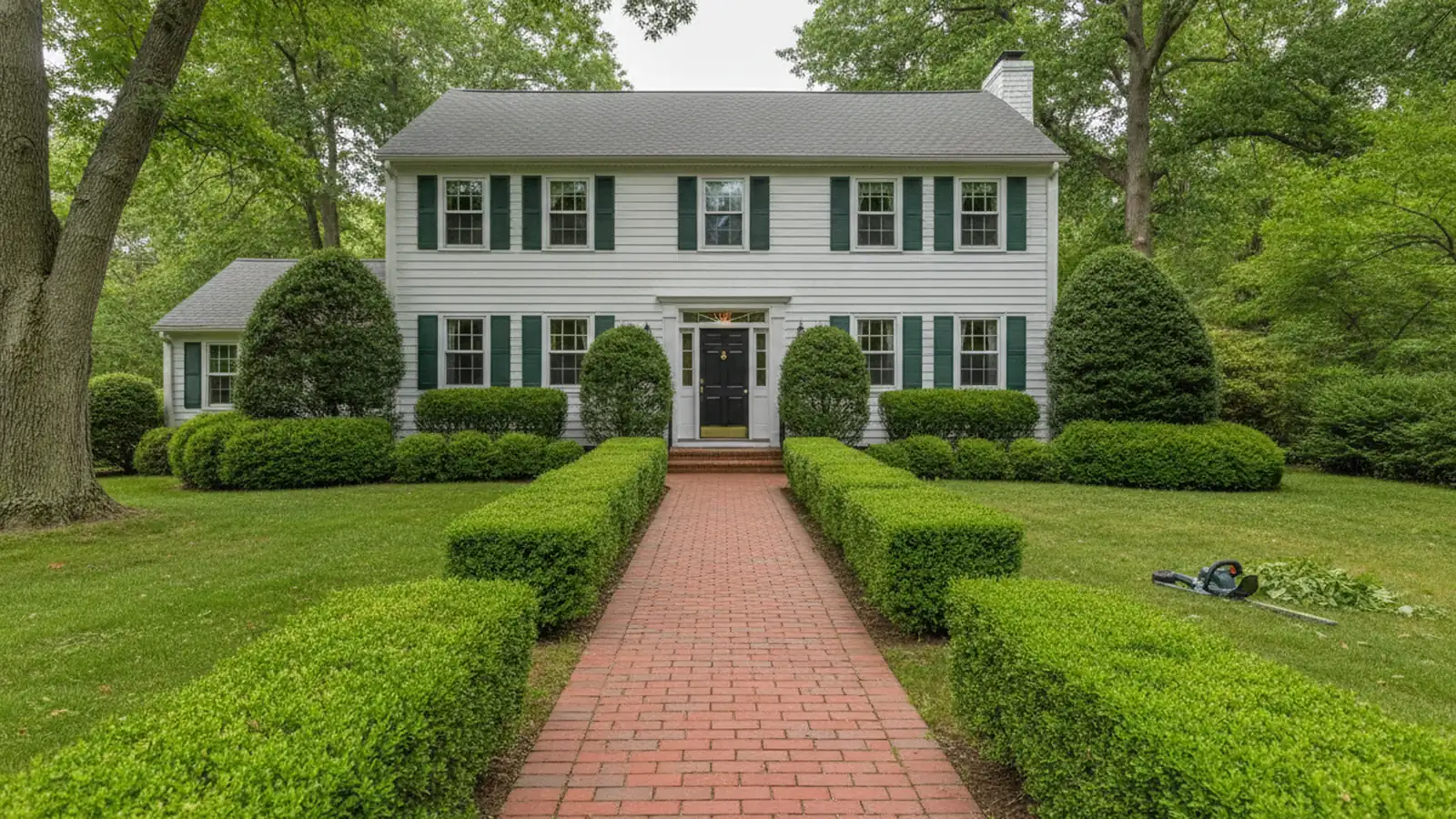
Hedge trimming in Hopedale, MA is a little different from shrub care in a typical suburb. Much of the town was planned by the Draper family as a model company village, with homes set in garden settings on the hills and valleys around Hopedale Pond. Many of those properties still carry foundation shrubs, front walk hedges and specimen plants that have been growing for decades. Some look great. Many have quietly outgrown the house.
This guide covers when to trim and prune in Hopedale, how to tell a shrub that needs a light shaping from one that needs a multi-year renovation, what to do about shade near the Parklands, and how shared lawns on double houses change the job. It is written for homeowners who do their own pruning and for anyone deciding whether to hand it off.
Why Hopedale yards have such old shrubs
Hopedale started in 1842 as a utopian community led by Adin Ballou and grew into a company town around the Draper loom works. The Drapers invested heavily in housing and landscape. The rows of double houses along Dutcher Street, built between 1902 and 1907, were larger and more spacious than typical mill housing, and the village was laid out to preserve views and green space. Much of the center is now the Hopedale Village Historic District, listed on the National Register of Historic Places in 2002.
That legacy means a lot of Hopedale homes are surrounded by mature yews, arborvitae, rhododendrons, lilacs, forsythia and old privet or barberry hedges. Over the years many were sheared into tight boxes or balls, year after year, until the outside is a thin green shell over bare, woody branches. They block windows, rub against siding and hold moisture against old clapboards. The good news is that most of these shrubs can be brought back, as long as the work is done in the right season and in stages.
When to trim and prune in Hopedale
Timing depends on whether a shrub flowers and when. The simplest rule for the plants common in Hopedale yards is this: prune spring bloomers right after they finish flowering, and prune summer bloomers and evergreens in late winter or early spring.
Lilac, forsythia, azalea, rhododendron and many viburnums set next year's flower buds over the summer. Trim them in late spring or early summer, within a few weeks after the flowers fade. If you cut them in fall, you cut off next spring's blooms.
Yews, boxwood, arborvitae and most formal hedges can be shaped in late spring, after the first flush of new growth, and given a light touch up in early to mid summer if needed. Avoid heavy pruning on evergreens from late summer into fall. New growth that sprouts after a late cut does not have time to harden before winter and often burns in the cold.
Hard renovation cuts on overgrown deciduous shrubs, like old lilacs or privet, are best done in late winter or very early spring while the plant is dormant. That gives the shrub a full growing season to push new shoots.
Shaping versus renovation: reading an overgrown shrub
A shrub that only needs shaping still has green growth inside the canopy when you part the branches. Trim the outer growth back to the size you want, keep the base slightly wider than the top so light reaches the lower branches, and you are done.
A shrub that needs renovation is green only on the outside. Shear it back to the size you want and you will be looking at bare brown wood for a long time. For these, the standard approach is staged renewal: remove about one third of the oldest, thickest stems at or near the ground each year for three years. Each round lets light and new shoots into the center, and by the third year you have a fuller, smaller shrub that fits the house again.
Yews are one of the few evergreens that tolerate hard cuts back into old wood, and they usually respond well over a season or two. Arborvitae and most junipers do not. Cut them back to bare wood and they rarely green up again. For those, the honest answer is sometimes to replace an overgrown plant with a new one sized for the spot, which is often cheaper over time than fighting it every year.
Shade, slopes and soil around Hopedale Pond
The streets near Hopedale Pond, the Parklands and the Mill River sit under heavy tree canopy. The Parklands alone cover more than 200 acres of woods designed by Warren Manning to wrap around the pond. Shrubs in that shade grow lanky as they reach for light, flower less and can pick up fungal problems when air does not move through them. Thinning cuts, which remove whole branches back to a main stem, help more here than shearing the outside.
Like most of Worcester County, Hopedale sits on stony glacial soil, and many lots slope. Shrubs on the high side of a hill dry out fast in July and August, while those at the bottom can sit in wet soil after a storm. A 2 to 3 inch layer of mulch over the root zone, kept a few inches away from the stems, helps both. It holds moisture on the dry side and keeps soil temperature steadier everywhere.
Water matters too. The Hopedale Water Department has put strict outdoor watering restrictions in place during dry summers, at times allowing only handheld watering on an odd and even schedule. Newly planted or freshly renovated shrubs are the most vulnerable, so plan big pruning and planting for spring or early fall, when rain usually does most of the work.
Double houses, shared hedges and keeping the street even
Many Hopedale double houses now have a different owner on each side. Shrubs and hedges that run across the front of the building are often split down the middle, and when one owner trims in May and the other in August, the house looks lopsided from the street.
If you share a hedge, it is worth agreeing with your neighbor on a height and a schedule. One crew trimming both halves in a single visit is the easiest way to keep the line straight. If that is not possible, match the height and shape your neighbor keeps, so the property reads as one clean frontage. The same goes for mowing height and bed edges on shared lawns.
Historic streets also have stone walls, granite curbing and older walkways. Hedges planted too close to them push roots and branches into the stone over time. Keeping a clear strip between the hedge and the wall or walk makes trimming easier and protects the stonework.
Cleanup, disposal and getting help
Pruning creates more debris than people expect. Branches from a full hedge renovation can fill a pickup truck. Hopedale's rules for brush and yard waste disposal can change, so check with the Town of Hopedale before you plan on dropping material off.
Sharp tools make a difference. Bypass pruners for stems up to about half an inch, loppers for larger stems, a pruning saw for anything thicker than your thumb, and hedge shears or a trimmer for formal hedges. Clean cuts just outside the branch collar heal faster than torn ones.
If you would rather hand off the work, Procopio Landscaping & Design is a family-owned crew based in Framingham that handles hedge trimming, shrub pruning, mulch and seasonal cleanups in Hopedale and nearby Milford. Estimates are free with no visit fee, we reply within 24 hours, and the team speaks English, Portuguese and Spanish.
Frequently asked questions
- When is the best time to trim hedges in Hopedale, MA?
- For most evergreen hedges like yew and boxwood, late spring after the first flush of growth, with an optional light touch up in early summer. Avoid heavy cuts from late summer into fall so new growth can harden before winter.
- When should I prune lilacs and forsythia?
- Right after they finish flowering in late spring. They form next year's buds over the summer, so pruning in fall or winter removes the flowers you would see the following spring.
- Can an overgrown yew be cut back hard?
- Usually yes. Yews tolerate cuts back into old wood and tend to push new growth within a season or two. Arborvitae and most junipers do not recover from cuts into bare wood, so those often need light shaping or replacement.
- How do I renovate old foundation shrubs without killing them?
- Use staged renewal. Remove about one third of the oldest stems at the base each year for three years, ideally in late winter for deciduous shrubs. Each round lets light into the center and the plant fills back in at a smaller size.
- How much does hedge trimming cost in Hopedale?
- It depends on the number and size of shrubs, how overgrown they are, access and how much debris has to be hauled away. A light seasonal trim costs far less than a full renovation. A free on-site estimate is the only way to get a real number.
Found this helpful? Make us a preferred source on Google.
Ready for an exact price?
Get a free, no-pressure in-home estimate. Real numbers for your home, not a phone guess.